

TTS Provider
Language, provider, model and voice all live in Voice & speech → Language & voice, and they are picked in that order: the provider list depends on the language you chose, so the dropdown only appears once a language is set. Available in Pipeline and Dualplex modes. Providers:- ElevenLabs - high-quality voices, a large library
- Cartesia - fast, low-latency synthesis
- Inworld - where enabled for your account; it does not support secondary languages
- Azure - available for a smaller set of languages
Models
Most providers offer more than one speech model, and the Models choice appears right under the provider when they do. It is the same voice either way — the model decides how fast it answers, how expressive it sounds, and which languages it can speak. Roughly, each provider offers a fast model and a more expressive one:
A model that cannot speak one of your languages is shown as Not available in the selected
language and cannot be picked. This is why a language sometimes leaves you only one model: it is
the only one that speaks it.
Changing the provider resets the model to that provider’s default. Changing the language keeps your
model when it can still speak it, and moves you to one that can when it cannot.
Voice Library
Each TTS provider has its own voice library. Select male/female, accent, or language based on your provider.Importing Voices from the Provider Library
Beyond the built-in catalog, you can import any public voice from your TTS provider’s own library (ElevenLabs Voice Library or Cartesia Library). Available in Pipeline and Dualplex modes. Steps:- Click “Import voice” next to the voice selector
- Pick the provider (ElevenLabs or Cartesia)
- Open the provider’s voice library and find a voice you like
- Copy the voice link or ID (the ⋮ menu next to the voice)
- Paste it in the import field and click Import
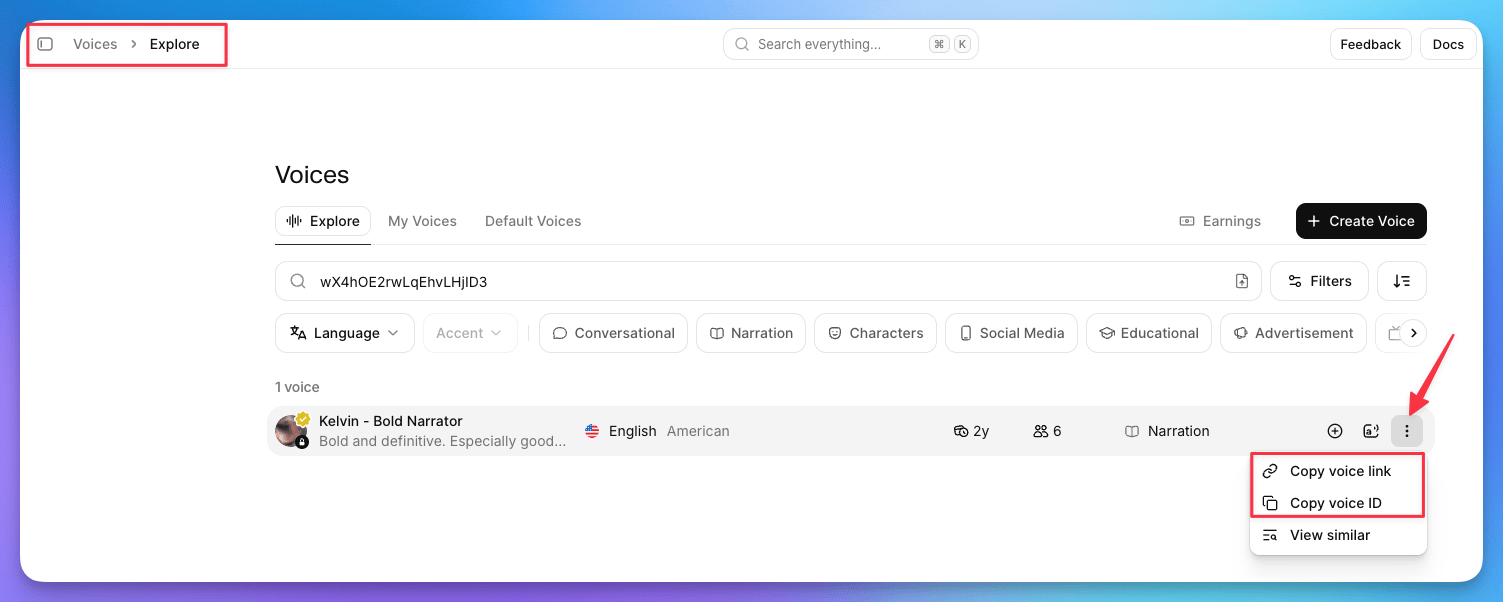
ElevenLabs Voice Library — copy the voice link or ID from the ⋮ menu
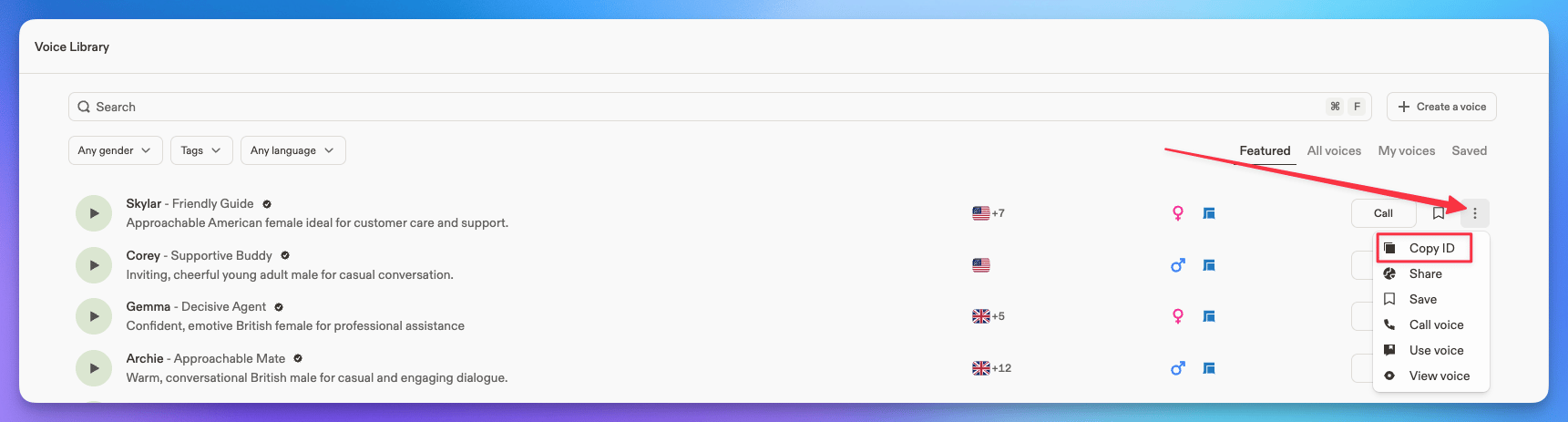
Cartesia Voice Library — copy the voice ID from the ⋮ menu
- ElevenLabs voices with a custom price set by their creator cannot be imported.
- Private or unshared voices cannot be imported — only public library voices.
Voices in Speech-to-Speech
In Speech-to-speech there is no separate synthesizer: the multimodal model speaks for itself. You pick that model in General → Engine type, as Multimodal model, and the voice picker offers the voices that model can use — multilingual ones, so there is no language filter and no provider to choose. Your own cloned voices stay in the list whatever the assistant’s language is.Voice Cloning
Clone a voice from an audio sample. Available in Pipeline and Dualplex modes, and limited by your plan — the picker tells you when you have used up your cloned voices. Clone to Provider:- Cartesia - Single audio file, at least 10 seconds, 1 speaker, no background noise
- ElevenLabs - Samples over 1 minute, 1 speaker, no background noise. Max 5 minutes total. Quality over quantity.
- Click “Clone voice” next to voice selector
- Select provider (Cartesia or ElevenLabs)
- Choose the voice language
- Enter a name for your voice
- Record or upload audio
- Wait for processing
- Select your new voice from dropdown
Best Practices
- High-Quality Audio: Clearer samples give better results
- Steady Delivery: Natural tone, no abrupt changes
- No Background Noise: Record in a quiet environment
- Legal: Ensure permission to clone voices that aren’t yours
Tip: After selecting or cloning a voice, do a test call to confirm it sounds as expected.