

Overview
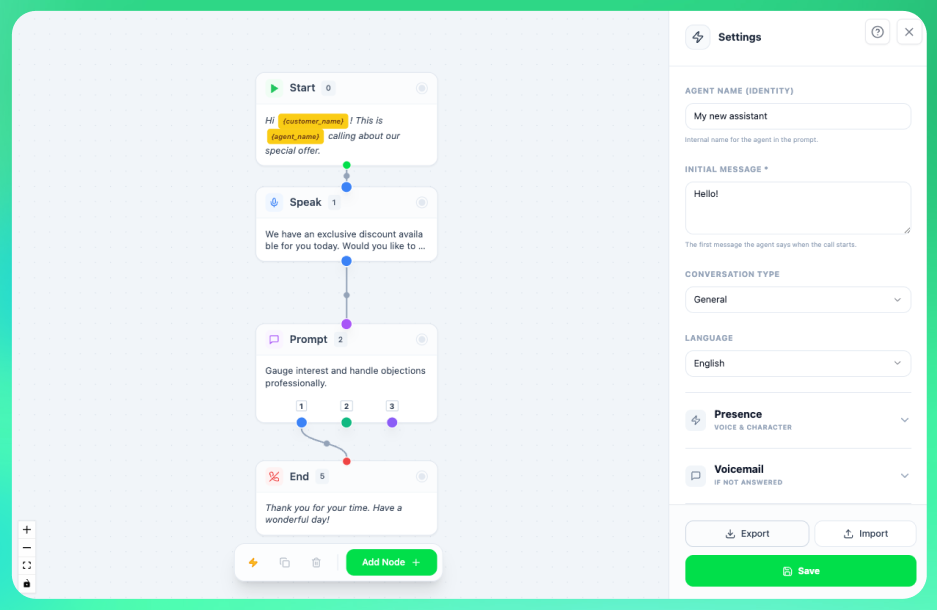
Flow Builder provides:- Visual design - Drag-and-drop nodes on a canvas
- Multiple node types - Messages, prompts, actions, and more
- Branching logic - Create different paths based on responses
- Settings panel - Configure agent personality and behavior
- Import/Export - Save and share flows as JSON files
When to Use Flow Builder
Use Flow Builder for
- Structured conversation scripts
- Multi-path decision trees
- Complex call flows with branches
- Visual thinkers who prefer diagrams
Use Classic Editor for
- Simple, linear conversations
- Highly dynamic AI responses
- Quick prompt iterations
- Text-focused editing
Getting Started
1
Open your assistant
Navigate to Assistants and click on the assistant you want to edit.
2
Find Flow Builder
Go to Brain & prompt in the sidebar, then the System Prompt section, and pick the Flow Builder card.
3
Launch Flow Builder
Click Launch Flow Builder. A full-screen editor will open.
4
Choose how to start
- Continue with existing - Edit your current flow
- Start from scratch - Begin with just a Start node
- Start with template - Load a pre-built flow template
Interface Overview
Canvas Area (Center)
The main workspace where you build your flow:- Nodes - Drag to reposition
- Connections - Lines showing flow between nodes
- Grid background - Helps with alignment
- Zoom controls - Zoom in/out and fit to view
- Pan - Click and drag on empty space to move around
Bottom Toolbar
Quick actions for managing your flow:Settings Panel (Right Side)
Configure your assistant’s personality and behavior:- Agent Name - The name your AI will use
- Agent Type - Sales, Support, Survey, etc.
- Language - Spoken language for calls
- Assertiveness - How pushy the AI should be
- Humor - Level of humor in responses
- Variables - Pre-call data fields
- Post-Call Fields - Data to collect after calls
Node Types
Flow Builder has 5 node types, each with a specific purpose: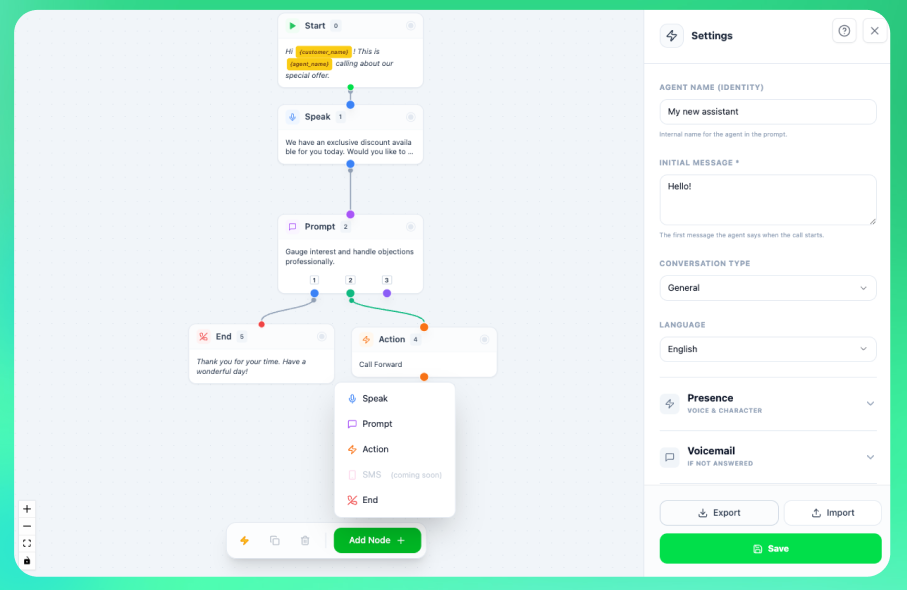
Start Node (Green)
Start Node
The entry point of every conversation. Every flow must have exactly one Start node.Properties:
- Greeting - The initial message when the call begins
Speak Node (Blue)
Speak Node
Delivers a pre-written message exactly as specified. Use when you need precise wording.Properties:
- Text - The exact message to speak
- Outcomes - Different paths based on customer response
Prompt Node (Purple)
Prompt Node
Gives the AI instructions on how to respond. More flexible than Speak nodes - the AI generates contextual responses.Properties:
- Prompt - Instructions for the AI
- Outcomes - Different paths based on response categories
Action Node (Orange)
Action Node
Executes special actions during the call.Action Types:
- Call Forward - Transfer to another number
- Book Appointment - Schedule using connected calendar
- Custom Action - Trigger a custom mid-call tool
End Node (Red)
End Node
Terminates the call or transfers to another destination.End Types:
- End Call - Hang up with a closing message
- Forward Call - Transfer to a phone number
- Transfer Agent - Hand off to another assistant
Working with Nodes
Adding Nodes
- Click + Add Node in the bottom toolbar
- Select the node type from the dropdown
- The node appears on the canvas
- Drag it to your desired position
Connecting Nodes
- Hover over a node’s bottom edge to see the output handle (small circle)
- Click and drag from the output handle
- Connect to another node’s input handle (top edge)
- Release to create the connection
Editing Nodes
- Click on any node to select it
- The node’s properties appear in a panel
- Edit the text, prompt, or settings
- Changes save automatically to the canvas
Deleting Nodes
- Select a node and press Delete key, or
- Select a node and click the 🗑️ button in the toolbar
Outcomes (Multiple Paths)
Speak and Prompt nodes can have multiple outcomes - different paths based on how the customer responds.Adding Outcomes
- Select a Speak or Prompt node
- In the properties panel, find Outcomes
- Click Add Outcome
- Name the outcome (e.g., “Interested”, “Not interested”, “Wants callback”)
Connecting Outcomes
Each outcome appears as a colored dot at the bottom of the node. Connect each outcome to a different destination node to create branching logic.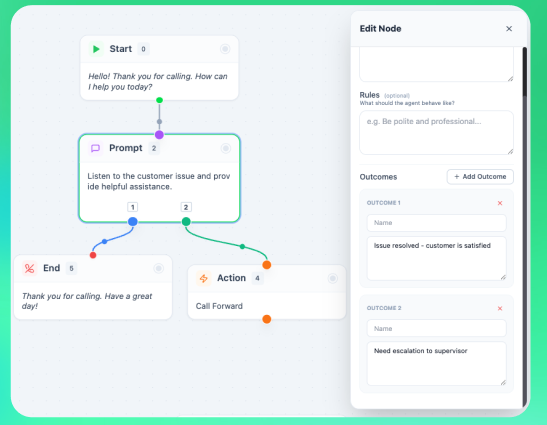
Settings Panel
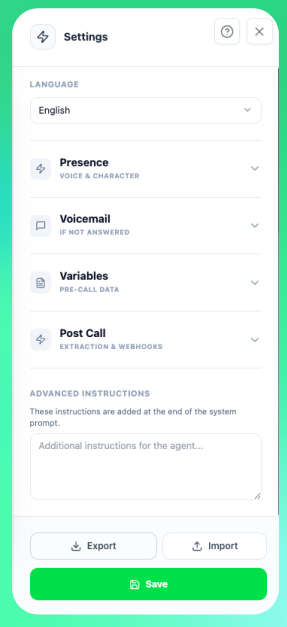
Agent Identity
Personality
Variables
Add pre-call data that can be used in your messages:- Click Add Variable
- Enter a Name (e.g.,
product_interest) - Set a Default Value
{variable_name}
Example: “Hi , I see you were interested in our .”
Post-Call Fields
Define data to extract from calls:- Click Add Field
- Enter Name, Type, and Description
- The AI will attempt to fill these based on the conversation
string, number, boolean, plus tags, object, list, and json in the full assistant settings
Import/Export
Export Your Flow
- Open the Settings panel
- Scroll to the bottom
- Click Export JSON
- Save the
.jsonfile
Import a Flow
- Click Import JSON in settings
- Select your
.jsonfile - The flow loads on the canvas
Voicemail Settings
Configure what happens when voicemail is detected:- Voicemail Message - Message to leave if voicemail answers
- End Call on Voicemail - Toggle to automatically hang up on voicemail
Saving Your Flow
Click the Save button in the top-right corner to save your flow to the assistant.The flow is stored as JSON in your assistant’s system prompt field. If you switch to the Classic Editor, you’ll see the raw JSON data.
Best Practices
Start Simple
Begin with a basic flow and add complexity gradually. Test at each step.
Use Prompt Nodes
Prompt nodes give the AI flexibility. Use them for dynamic, context-aware responses.
Plan Your Outcomes
Before building, sketch the main paths: positive, negative, and neutral responses.
Test Thoroughly
Make test calls covering all paths. Verify each outcome leads to the right destination.
Troubleshooting
Nodes won't connect
Nodes won't connect
- Ensure you’re dragging from an output handle (bottom) to an input handle (top)
- Check that you’re not creating a circular connection
- The Start node only has an output, End node only has an input
Flow not saving
Flow not saving
- Check your internet connection
- Ensure you have at least one node (besides Start)
- Look for any validation errors in the settings panel
AI not following the flow
AI not following the flow
- Use Speak nodes for exact wording requirements
- Make Prompt node instructions more specific
- Check that outcomes are clearly defined and connected
Related Resources
- AI Prompt Editor - Chat-based alternative for prompt editing
- System Prompts Guide - Understanding prompt fundamentals
- Testing Your Assistant - How to test your flows